Give Both Samples the Same Work
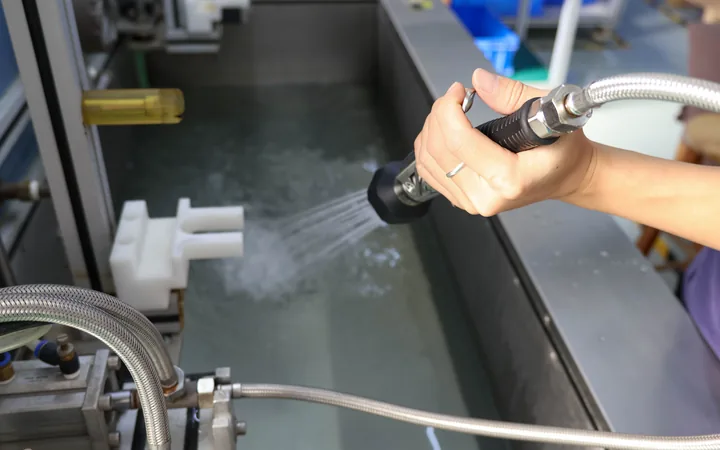
Take two comparable loads from a normal shift and agree what can go into the dishwasher. For example, the operator may need to clear the loose scraps and lift the visible sauce from the corners of a tray. Match the dish count, the amount of residue and how long it has sat. Keep the hose and sink setup the same when the samples can use the same connection. Have the same operator run both, then switch the order on the next pair.
Write down the inlet pressure while water is flowing, the water temperature and whether another outlet is drawing water. Time the whole job from picking up the ware to setting it down. Record trigger-open time separately. Use a meter on the spray valve’s supply, or arrange a reading with all other outlets on that meter idle. Include every extra pass in the water total.
A sample sheet might show four plates ready for the washer, with three clear on the first pass. The example meter rises from 102.4 to 104.8 L. That’s 2.4 L for the group, or 0.60 L per plate, including the extra pass. Keep the first-pass count beside the water figure. It tells the next shift where the work went.
A Steakhouse Used Almost the Same Water With Two Different Valves
In EPA’s 2010 field study at Jimmy’s Steer House near Boston, anonymous valve I flowed at 1.14 U.S. gpm, used 120.1 U.S. gallons per day and was open for 112.4 minutes per day. Valve D ran at 1.35 U.S. gpm, used 119.9 U.S. gallons per day and was open for 94.1 minutes per day. The team monitored them in separate periods. It recorded 55 and 53 psi while flowing, respectively. Across the study sites, higher-efficiency valves generally used less water. The steakhouse readings show why a receiving sheet needs both run time and the meter reading.
Read the Curve for the Spray Valve in the Box
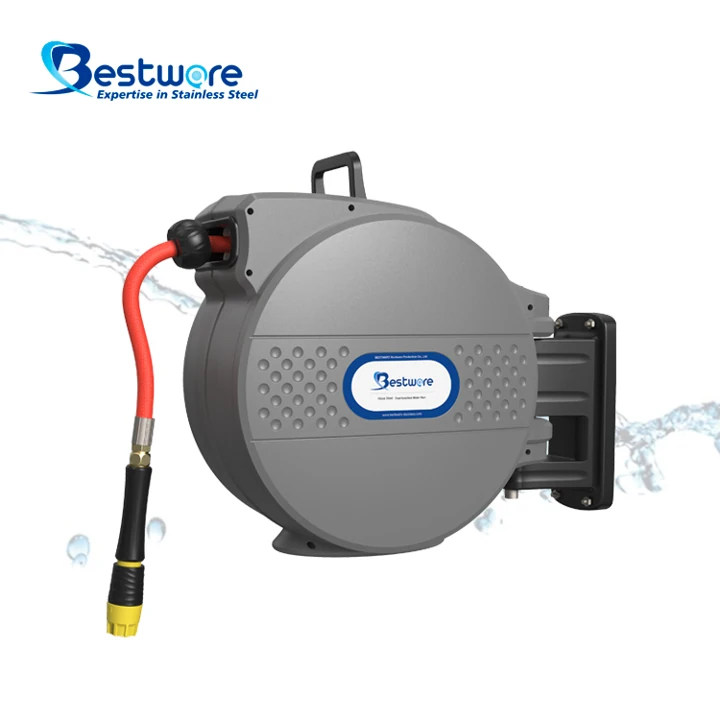
For example, the published Bestware AS112 configuration lists BWSG-SSE as standard and BWSG-SSJ as optional. At the 2.5 bar point on the manufacturer’s curves, the SSE is marked 3.7 L/min on its concentrated setting and 8.0 L/min on its wide setting. The SSJ has one concentrated setting, marked 3.4 L/min. Use the marked point to see how far the settings can differ. Run the kitchen trial at the supply conditions agreed for the installation. Use a report at 60 ± 2 psi dynamic pressure for the U.S. federal check, with flow and spray force for the exact basic model and every tested setting.
The AS112 swing spout has its own 8 or 15 L/min aerator options. Check the part number and outlet on the order. Put the wide pattern on the flat face of a tray and check concentrated spray at the corners with stubborn residue. If the order includes both patterns, log the two runs separately so the next operator can repeat the check.
Watch What Happens When the Operator Lets Go
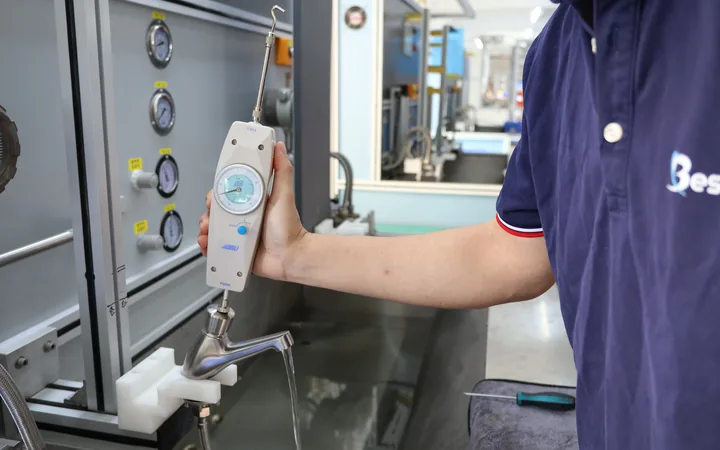
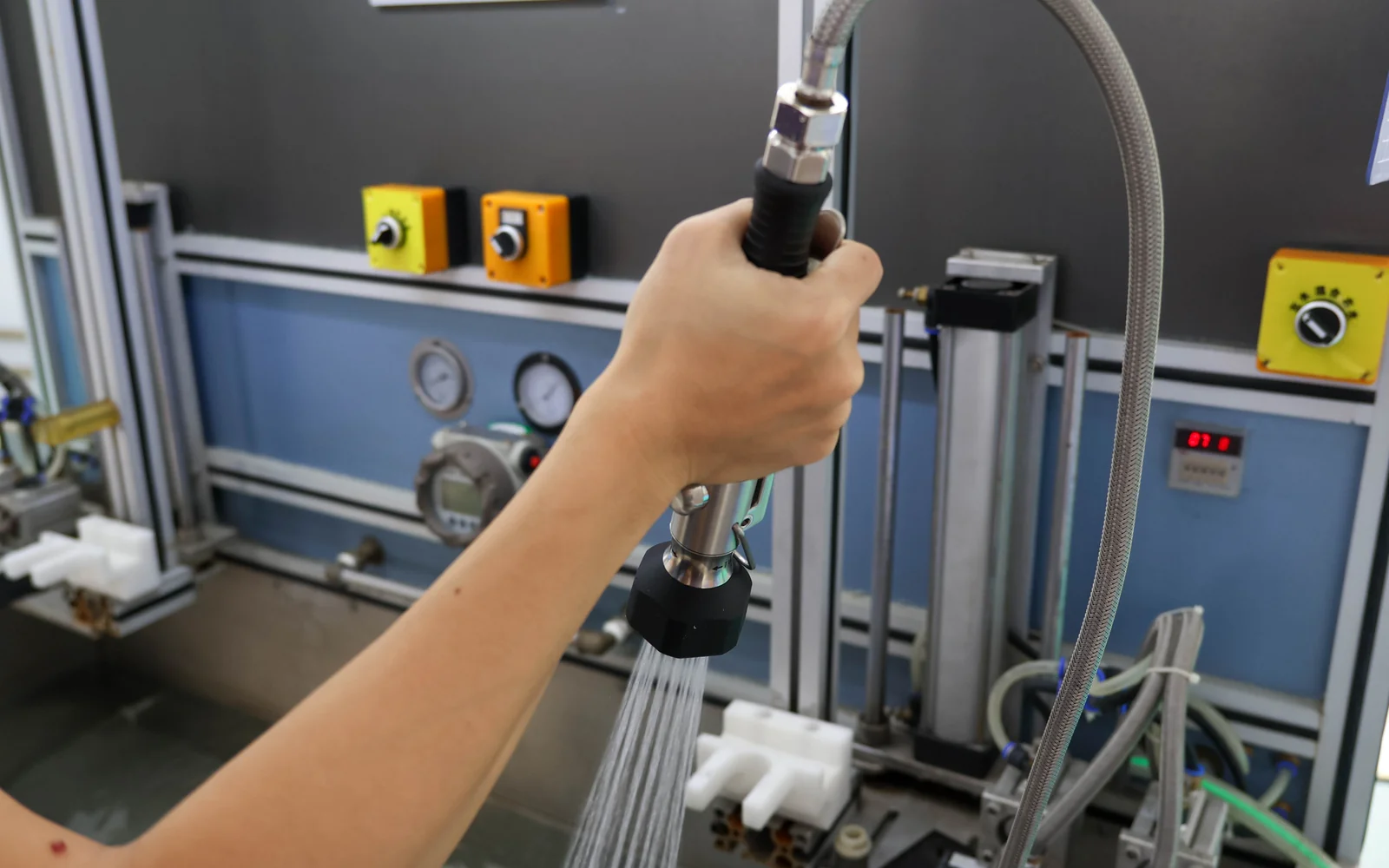
Disengage the hold-down ring so the trigger can close. Reach the far corners of the sink as you would during service and watch for strain at the hose joint. If water keeps flowing after release, a fitting leaks or spray reaches an adjacent clean area, hold sign-off and record where it happened. Note the fitted valve and hose, then repeat the check under the same conditions after the repair.
Match the U.S. Test Record to the Supplied Valve
For covered U.S. valves manufactured on or after January 28, 2019, 10 CFR 431.266 ties maximum flow to measured spray force. The limits are 1.00 U.S. gpm at up to 5.0 ozf, 1.20 U.S. gpm above 5.0 through 8.0 ozf, and 1.28 U.S. gpm above 8.0 ozf. Under §431.264, every selectable pattern or spray face goes through both measurements. Use the formal results at the prescribed test pressure for the exact basic model and configuration on the order. EPA stopped awarding the WaterSense label for this category on January 1, 2019.
A matching DOE flow-and-force record for BWSG-SSE or BWSG-SSJ is still to be verified. If the order is for the U.S., ask the supplier to identify the valve, the settings covered and the corresponding basic model before approving the paperwork. File that record with the valve and hose references and the kitchen receiving sheet.
Sources for This Edition
- Four-Plate Receiving Trial and Meter Example · Proposed receiving protocol and invented meter readings, not an observed test. Three plates clear on the first pass and the fourth clears after another pass. All four are ready for the next wash step. An isolated meter rises from 102.4 to 104.8 L, or 2.4 L total and 0.60 L per plate, including rework. No product, target or expected result is implied.
- U.S. EPA WaterSense — Pre-Rinse Spray Valves Field Study Report · March 31, 2011. Table 6, printed p. 17, Jimmy’s Steer House. Anonymous I: 1.14 US gpm, 120.1 US gal/day, 112.4 min/day, 55 psi flowing, 83.7 °F. Anonymous D: 1.35 US gpm, 119.9 US gal/day, 94.1 min/day, 53 psi flowing, 82.6 °F. Table D-23 identifies distinct monitoring periods, with a boil-water event affecting a separate sample A. Section 6.1 describes the general pattern across the study.
- Bestware BWSG-SSE — Dual-Function Spray Valve · Product Specifications, Spray Valve Flow Mode and Spray Valve Water Flow > Flow Rate Curve. At the marked 2.5 bar coordinate the manufacturer gives 3.7 L/min in Powerful Washing and 8.0 L/min in Large-area Washing. Product curve only.
- Bestware BWSG-SSJ — Single-Function Spray Valve · Product Specifications, Spray Valve Flow Mode and Spray Valve Water Flow > Flow Rate Curve. At the marked 2.5 bar coordinate the product-specific manufacturer curve gives 3.4 L/min in Powerful Washing. The current AS112 configuration page points to a separate image with the same values. The broader buyer guide shows a different SSJ curve and must be kept separate.
- Bestware AS112 — Commercial Pre-Rinse Faucet Configuration · Specifications rows 7–10 and 15–16. BWSG-SSE standard and BWSG-SSJ optional, distinct hand-spray curves, and separate swing-spout aerator options of 8 or 15 L/min. Applies to the published assembly, confirm the ordered configuration.
- Bestware Commercial Faucet FAQ — Spray Valve Hold-Down Ring · Pre-rinse faucet question on one-handed operation explains the hold-down ring for continuous spray. General FAQ on replacement products and spare parts. Fit, shutdown and specific parts checks in this guide are receiving recommendations.
- 10 CFR 431 Subpart O — Commercial Prerinse Spray Valves · Checked November 24, 2026. §431.262 scope and basic-model definition. §431.263 incorporates ASTM F2324-13 (R2019). §431.264(c) requires flow and force for each setting or spray face. §431.264(d) governs voluntary pressure representations. §431.266(b) class flow limits for covered valves manufactured on or after January 28, 2019.
- 10 CFR 429.51 — Commercial Pre-Rinse Spray Valve Certification Reports · §429.51(b)(2) lists the publicly reportable flow (gpm to 0.01) and corresponding spray force (ozf to 0.1). Exact-model lookup in DOE’s public group and the original manufacturer pages did not verify matches for BWSG-SSE or BWSG-SSJ. The full CCMS export was unavailable in the review environment.
- U.S. EPA — Pre-Rinse Spray Valve WaterSense Specification History · Specification heading says WaterSense stopped awarding labels under this product specification January 1, 2019. Performance summary discusses field use, spray forces and life-cycle failures.
- Bestware — Verify the Scope of a Water Equipment Certificate · Same-language guide to model coverage, evidence and document verification.
- U.S. DOE final test procedure · Federal Register 87 FR 13901 · PDF pp. 5–6, Section C, Water Pressure, and footnote 6. The formal test uses 60 ± 2 psi dynamic pressure upstream.
Continue With These Decisions
- Replacing a Commercial Tap? Measure the Existing Counter First
Check the method and what to record.
- How to Trace a Stainless Steel Grade to the Delivered Part
Check the method and what to record.
- How to Test a Pre-Rinse Faucet in a Food Truck
For a food truck, repeat the trial with its approved pump, tank and drainage.