Check the Smallest Particle in the Count
Before deciding which water had more microplastics, find the lowest size in each report and check what the number counts. Particles per liter tells you how many the lab counted in a volume of water. Micrograms per liter tells you their mass in that volume. A report that gives only the mass leaves you without a particle count.
The table uses two hypothetical readings from the same water. A method counting from 1 µm reports 40 particles/L. Restrict that tally to particles at least 20 µm and 8 remain. The other 32 fell below the second method’s size window. The lab would also need to identify their material before calling them plastic. In a real comparison, check the volume processed, the sampling point and the blank the lab used to check what the procedure itself may have introduced. If the lab reports “not detected,” keep the lower size boundary and the lab’s reporting limit with that result.
The EU’s 2024 drinking-water method groups particles starting at 20 µm and reports the count per cubic meter. Twenty micrometers is a measurement boundary for that method. To match it against a research total beginning at 1 µm, ask for the shared size range as well as comparable units.
| Minimum Size Counted | Illustrative Count per Liter |
|---|---|
| 1 µm | 40 (8 larger + 32 smaller) |
| 20 µm | 8 (larger particles only) |
What the Bottled-Water Study Actually Counted
In January 2024, Naixin Qian and colleagues used stimulated Raman scattering to identify particles matching seven polymer types. Across samples from three bottled-water brands, they estimated a mean of roughly 240,000 plastic particles/L. About 90% of the estimated count was smaller than 1 µm. The team demonstrated detection around 100 nm with test particles. The reported sample count comes from the study’s own method and library.
A later exchange in PNAS focused on the blank. Dušan Materić argued that the clean filter used as the control missed contamination from the rest of the procedure. Qian’s team replied that the laboratory water proposed as the blank already contained plastic particles. In the reply, they showed that those polymers came in a different mix from the bottled sample they called Brand B. The control the team used was an Anodisc filter exposed to the same lab air, with no water passed through it. The exchange gives a reason to read the quality-control notes when the 240,000 figure appears in a headline.
What One Tap Sample Can Tell You
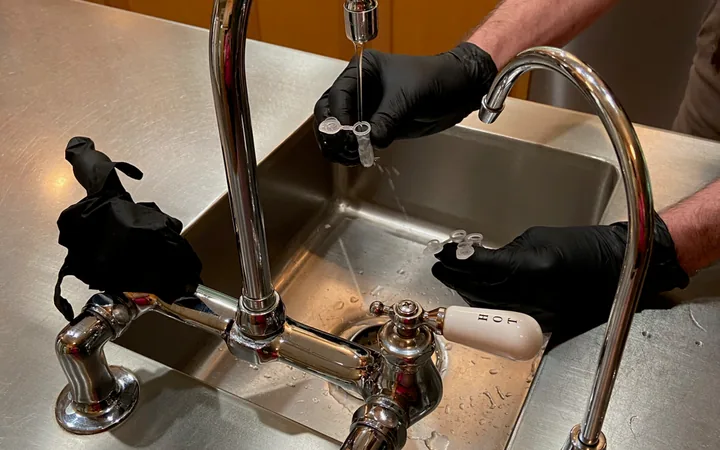
The January 2025 paper by Oskar Hagelskjær and colleagues gives an example of looking at both kinds of water with the same method. The team used Raman microspectroscopy on particles at least 1 µm in area-equivalent diameter. In ten French bottled-water samples representing ten brands, the corrected counts ranged from 19 to 1,154 particles/L. The team reported 413 particles/L from a single laboratory tap sample in Toulouse. That one number fell inside the bottled-water range. It tells you where one sample sat among these eleven.
Both papers measured particles in water. For the question about health, the FDA says the current evidence has not demonstrated that the levels found in tap or bottled water pose a risk to human health. EFSA’s October 2026 update says its scientific advice on microplastics in food, water and air is scheduled for the end of 2027.
What Belongs on the Filter Quote
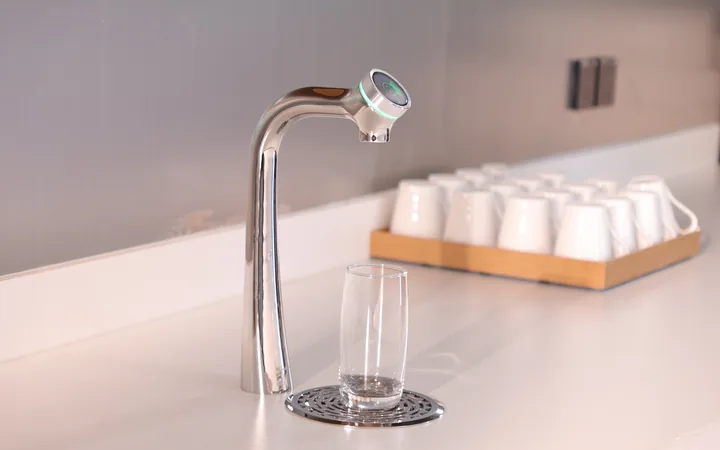
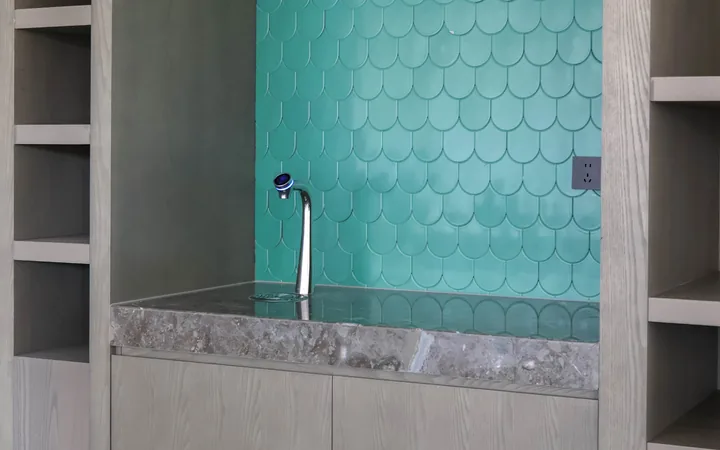
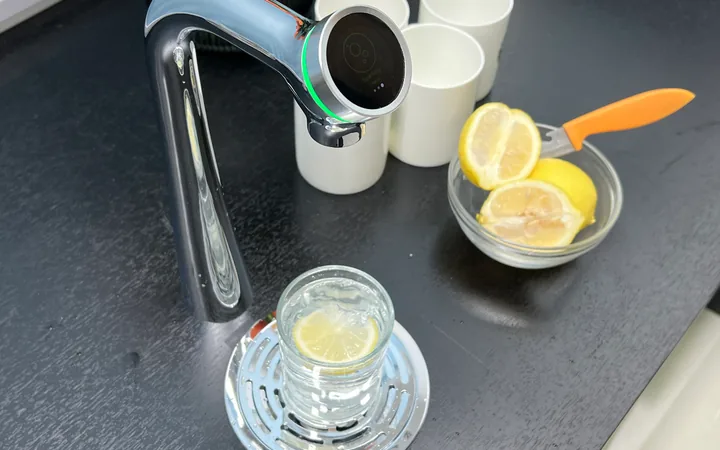
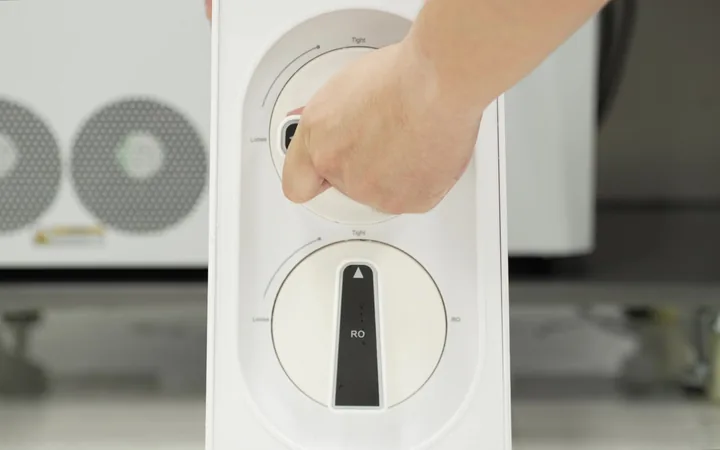
Suppose a restaurant quotes a Bestware G1DS-1023 for the drinks counter and a filter for a specified microplastics-reduction requirement. Give the dispenser and the proposed filter their own lines on the quote. Ask for the exact filter model, the replacement element and the certifier’s entry for that combination. The NSF directory shows the claim as “Microplastics Reduction” under Standard 401. A standard number by itself leaves the claim unresolved.
Check the listed flow and service cycle where available and confirm that they suit the branch feeding the machine. If the project specifies a particle-size range, ask what the performance sheet actually measured. For an on-site comparison, have the lab use the same size range and procedure on matched inlet and outlet samples, and record how the equipment was running when the samples were taken.
Sources for This Edition
- Hagelskjær et al. · Majority of potable water microplastics are smaller than the 20 μm EU methodology limit for consumable water quality · Published January 15, 2025. DOI 10.1371/journal.pwat.0000250. §§2.1–2.2, 3.1 and 5.1–5.2 and Fig. 1 for sampling, counting and correction.
- Columbia University · Qian et al.’s original SRS bottled-water study · Columbia University’s account links the paper published online January 8, 2024. In the original DOI 10.1073/pnas.2300582121 see the abstract, polymer identification and Fig. 5C.
- Materić · Nanoplastics measurements must have appropriate blanks · PNAS, November 15, 2024, DOI 10.1073/pnas.2411099121. See Fig. 1 and discussion of the procedural blank and dry-filter control.
- Qian et al. · Reply to Materić: Appropriate blanks should avoid major contamination sources in the lab · PNAS, November 15, 2024, DOI 10.1073/pnas.2415874121. See Fig. 1 and reasons for rejecting Milli-Q as the procedural blank.
- EU Publications Office · Commission Delegated Decision (EU) 2024/1441 · Adopted March 11, 2024. OJ May 21, 2024. In the Annex, definitions (8), (16), and (18) and method points (2), (3), and (16).
- U.S. FDA · Microplastics and Nanoplastics in Foods · Drinking water discussion and the current evidence statement. Accessed November 25, 2026.
- EFSA · Microplastics and nanoplastics in food · Last reviewed October 21, 2026. Latest and FAQ sections. EFSA’s scientific advice is scheduled by end-2027.
- NSF · Standard 401 listings for Microplastics Reduction · See the Standard 401 Microplastics Reduction claim, system and replacement-element columns, and listed flow and service cycle where applicable. Checked November 25, 2026.
- Bestware · G1DS-1023 product specifications · Commercial water dispenser and its separate RO Filtration Unit specification group. Source for the station selection context.
- Bestware Wiki · Selecting contaminant-specific filters · Match the site’s treatment requirement to an explicit model-level claim.
- Bestware Wiki · NSF point-of-use scope · Read complete system and replacement-element listings, and check rating conditions.
Continue With These Decisions
- How to Choose a Water Filter for a Named Contaminant
Match the site’s treatment requirement to an explicit model-level claim.
- Does a Point-of-Use Water Filter Need NSF 61?
Read complete system and replacement-element listings, and check rating conditions.