Map Refill Access After Airport Security
Place the first bottle refill point after airport security along the way to the gates, where travelers can see the direction without stepping out of the main flow. Then draw the routes from an arrivals gate to baggage claim and from the transfer junction toward a connecting flight. For each, mark a refill station people can reach while staying in their permitted area. An icon just across a wall or one floor away can belong to a different route entirely.
Hong Kong International Airport’s Terminal 1 directory makes the distinction clear. In the Midfield Concourse it lists a drinking fountain near Gate 209 on the arrivals level, L5, and another near Gate 209 on the departures level, L6. The gate number alone sends the traveler to two possible places. Brussels Airport tells travelers that they can refill free on both sides of security and asks them to empty bottles before screening. Santander Airport’s operator gave two separate landmarks in its 2023 announcement: the public check-in area by information, and the departure lounge. Keep the level, access zone and a useful landmark beside every point your own map shows.
Put the Direction Before the Turn
Stand where a traveler first has to choose between two corridors. Put the refill direction where it can be read from that position, then confirm the name and icon at the outlet. Follow the same wording on the terminal map and the information-desk script. Use distinct signs for emptying a bottle before a checkpoint, drinking from a fountain, and filling a bottle to take away.
In 1990 fieldwork at Chicago O’Hare, Anthony D. Andre combined passenger interviews with observations of people using the terminal maps. His 1991 paper reported difficulty using some maps and complaints about corridor signs. Use the method locally. Ask someone unfamiliar with the concourse to find water with only the signs passengers will see. Note the first wrong turn and exactly what was visible from it. If they reach the correct restroom entrance and overlook the refill point, move the final cue into their line of sight.
Time the Whole Fill, Including the Changeover
During a departure peak, log the walk from the decision point, time in line and time at the outlet separately. At the outlet, start the clock when a traveler begins positioning a bottle and stop when the next traveler can step in. The water-on time helps compare fixtures. The full cycle tells you how quickly the line can move.
Suppose a 500 mL bottle takes 12 seconds to fill and positioning, removing the bottle and changing users take another 8. With a steady 20-second cycle, a single outlet can complete at most 45 fills in 15 minutes. If 54 people seek a fill in that window, at least 9 are still unserved at the end, even under continuous ideal operation. These are planning inputs. Use observed arrivals and cycles for the terminal, then compare a second station on the same route with a better layout at the first. A queue that spills across the gate path calls for a layout change even if the outlet fills fast.
Test the Space With Luggage in It
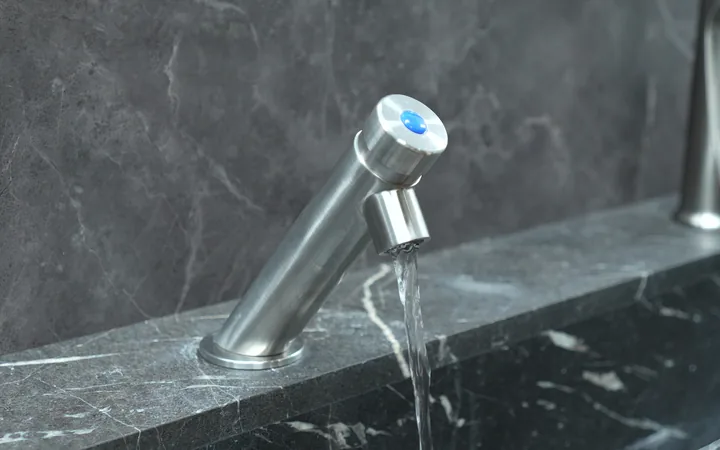
Walk the approach with a wheeled bag and a large reusable bottle, and include wheelchair users in the trial. Set out the bin and cleaning cart where they normally go. Check whether a traveler can get to the control, hold the bottle under the outlet and leave without reversing through the line. Ask the designer to verify the applicable requirements on the installed point.
For Chinese transport-airport passenger terminals, the civil aviation guide’s §6.3.6 sets the low drinking outlet at 700–850 mm above the floor, with knee clearance below. It also addresses wheelchair turning space and accessible signage. Use that as a separate site check from clearance for a tall bottle. Record both results on the installation drawing.
Check the approach, control reach and fixture at an accessible drinking point
Keep the Next Point Open and Easy to Name
At Minneapolis–Saint Paul, the airport operator reports a campaign and 10 additions to a 70-unit network. The 2024 report records 8.5 million uses, 27% more than in 2023. The total covers a network that was both promoted and expanded. Log usage, downtime and peak queues by station, then compare the same route at similar times before and after a change.
Give each station an ID that appears on the public map and the service sheet. Record who cleans it, who changes its status and which open point to name on the same route. At handover, take one station out of service in a supervised trial and walk the directions shown to a passenger. Check that the alternative is open at that hour and reachable with the same access and accessibility needs. Update the sign, digital map and desk information in the same shift.
Put route, fixture and service checks on the handover record
Sources for This Edition
- Brussels Airport — Drinking water · The passenger page identifies free refill on both sides of security and asks travelers to empty bottles before screening.
- Hong Kong International Airport — Drinking Water Facilities · Terminal 1 list, including arrivals at L5 and departures at L6 near Gate 209 in the Midfield Concourse.
- Aena — El Aeropuerto Seve Ballesteros-Santander instala dos fuentes de agua · 19 April 2023 announcement, page 1, location by the information desk in the check-in area and a second source in the departure lounge. Both are by restroom entrances.
- Anthony D. Andre — Human Orientation and Wayfinding in Airport Passenger Terminals · Transportation Research Record 1298 (1991), pp. 25–32, especially p. 27 for methods. O’Hare Terminals 1 and 2, spring 1990 fieldwork, including passenger interviews and map observation.
- 中国民用航空局 — 运输机场旅客航站区无障碍环境规划建设指南 AC-158-CA-2025-01 · Section 6.3.6, items 4, 5, 8 and 9, and Figure 6.3.6-5. Low drinking points, wheelchair turning space and signs in Chinese transport-airport terminals.
- Metropolitan Airports Commission — Sustainability Annual Report 2024 · Published 31 January 2025, printed p. 6 (PDF page 9), Promoting reusable bottles and refill stations. Network expansion, promotion and annual usage reported by the operator.
- Bestware Wiki — Accessible Drinking Water Points · Verify the user route, clearances and controls at the installed fixture.
- Bestware Wiki — Water Dispenser Installation and Handover · Record the responsibilities, tests and on-site service checks at handover.
Continue With These Decisions
- How to Specify an Accessible Drinking Water Point
Check the approach, control reach and fixture at an accessible drinking point
- Water Dispenser Installation and Handover: What to Sign Off
Put route, fixture and service checks on the handover record